
Kramer testing new model in Twins Cup at VIR
A new motorcycle in the MotoAmerica paddock drew plenty of attention when Krämer arrived at Virginia International Raceway with a 790-powered GP2 prototype. The most important thing to understand is that this motorcycle is not competing for championship points; it is at the track as a test and a proof of concept.
Krämer built the prototype to explore two separate but related questions: Could the company produce a more affordable and serviceable version of its GP2 platform, and could a motorcycle like that potentially have a place within MotoAmerica?
For now, there are no guarantees about what happens beyond this test.
“This is here for a proof of concept,” Krämer founder and CEO Joe Karvonen explained. “What happens beyond that, I don’t know. That’s not up to us. We’re just answering a call for what else is possible and what else can be done.”
Krämer’s existing GP2 lineup has already proven itself in competition, including in British Superbike support classes and in the United States. The company also produced the KTM RC 8C, which shares its basic chassis platform with Krämer’s GP2 machinery. The motorcycle being tested in MotoAmerica uses that already-developed GP2 chassis with a stock KTM 790 Duke engine.
According to Krämer, the engine is completely standard. It came from a 2024 KTM 790 Duke and was installed without internal modifications. The company says the donor bike was purchased off of eBay and they aren’t even totally sure how many miles it had on it before this weekend. It does produce approximately 100 horsepower, placing it near the performance level of the leading motorcycles already competing in the Twins Cup.
This initial prototype was assembled in only a matter of weeks, but that does not mean it was developed without direction. Krämer already had years of experience with both the chassis and the 790 engine. In fact, the 790 was the original engine around which the GP2 family was developed before the 890 became available.
The company’s higher-spec GP2 890 RR uses expensive racing components, including titanium connecting rods, titanium valves and a CNC-ported cylinder head. While those parts provide additional performance, they also increase both the initial cost of the motorcycle and the potential cost of ownership.
The 790 prototype takes a different approach as the goal was not to build the most powerful motorcycle possible. Instead, Krämer wanted to create a more approachable version of its GP2 platform; a version that would cost less to purchase, be easier to maintain and carry a lower financial risk if the engine ever needed to be repaired or replaced.
Krämer is targeting a turnkey price somewhere between $35,000 and $40,000, although the final price would depend on the eventual specification of a production version. That could be a combination that makes the motorcycle an attractive option for racers who want a purpose-built machine without the expense and maintenance demands of Krämer’s top-tier platform.
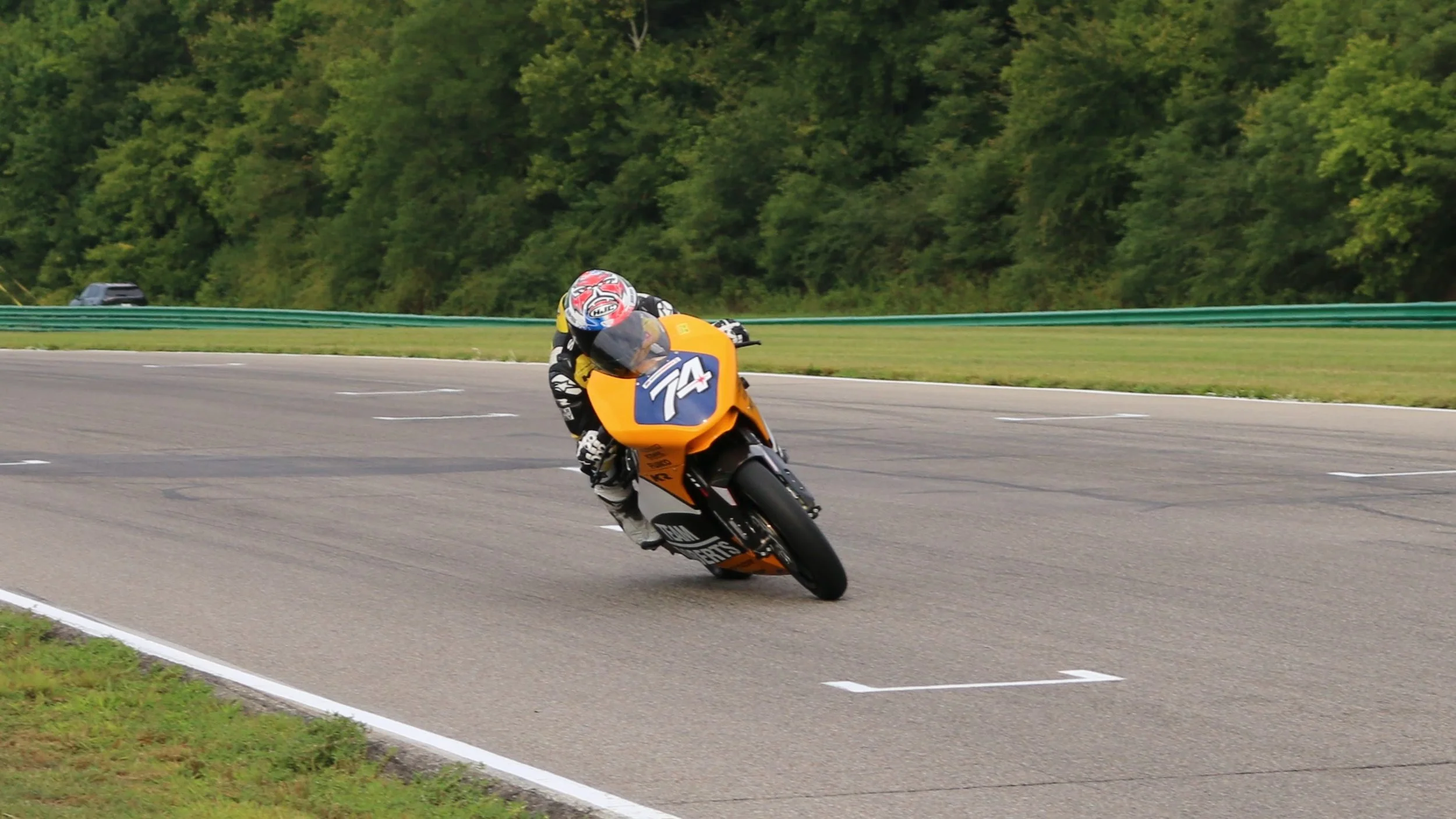
Kensei Matsudaira navigates the Krämer GP790R around Virginia International Raceway
Team Roberts became involved in the project because of its previous experience racing KTM 790 engines in dirt track competition. The team provided the drivetrain for the prototype and is working with Krämer throughout this weekend. Talent Cup points leader Kensei Matsudaira was selected to ride the motorcycle because of his ability to provide useful feedback and his relationship with Team Roberts.
Although the motorcycle is appearing during a MotoAmerica race weekend, Krämer emphasized that Matsudaira is not eligible to score points, claim an official finishing position or affect the championship standings.
“We’re not taking points from anyone,” Karvonen said. “We’re not scoring anything. We’re just spinning laps.”
That clarification is especially important during a weekend where the Twins Cup championship will potentially be decided. The team has also instructed Matsudaira to prioritize a safe and clean race over an outright result. The purpose of the weekend is to collect data, confirm that the motorcycle works properly in race conditions and evaluate how it performs around other motorcycles.
This new Krämer GP790R is also being closely monitored by MotoAmerica technical officials. Krämer is sharing its data with the sanctioning body, and the bike has been weighed by the stewards repeatedly throughout the weekend.
The presence of a purpose-built GP-style chassis in a class traditionally based around production street motorcycles has also created debate. Krämer does not build street motorcycles. Its philosophy is that a racebike should be designed as a racebike from the beginning rather than converted from a street platform. That approach differs from the motorcycles currently found in Twins Cup; machines based on the Yamaha R7, Suzuki GSX-8R and Aprilia RS 660.
Krämer understands why some competitors may question whether its prototype belongs in the class but they also point out that the decision is ultimately MotoAmerica’s—not Krämer’s.
This weekend is not an announcement that the motorcycle has been approved for future Twins Cup competition. It is simply an opportunity for MotoAmerica and Krämer to gather information.
MotoAmerica may eventually decide that a purpose-built motorcycle does not fit the direction of the class. The prototype could also require additional weight, performance balancing or other restrictions before it could ever be considered for regular competition.
“At the end of the day, this was just an opportunity where they said ‘Hey, we want to see what this thing can do.” added Karvonen. “We essentially just answered that call.”
